The strongest visual anchor
Two Tang tombs. One year. Different evidence.
The most specific dog image is Falconer Playing with Dog from Prince Yide’s tomb, securely dated to 706 CE. Its long-legged, narrow-waisted hound is close to the form later called xigou in the Guanzhong region.
Prince Zhanghuai’s nearby tomb also belongs to a 706 state reburial programme and contains a hunting procession with hounds. The two works are often blurred together online. They should not be: the Yide panel provides the close dog-and-falconer scene, while the Zhanghuai mural provides the larger hunting context.
Neither image supplies a modern regional name or a continuous pedigree. They document specialised sighthound-like dogs in elite Tang culture in the area; identifying them as a living standardised population would add more than the objects themselves can prove.
Sources: Tang tomb mural catalogue — Prince Yide; University of Michigan — Prince Zhanghuai; Shaanxi History Museum.
Resemblance is evidence for a tradition. It is not proof of an unbroken breed.
Eighteenth-century court art
What the Qing inscriptions preserve.
The Qianlong court’s dog portraits preserve individual names and tribute origins. They are unusually rich records of valued hounds, but their inscriptions do not use today’s regional taxonomy.
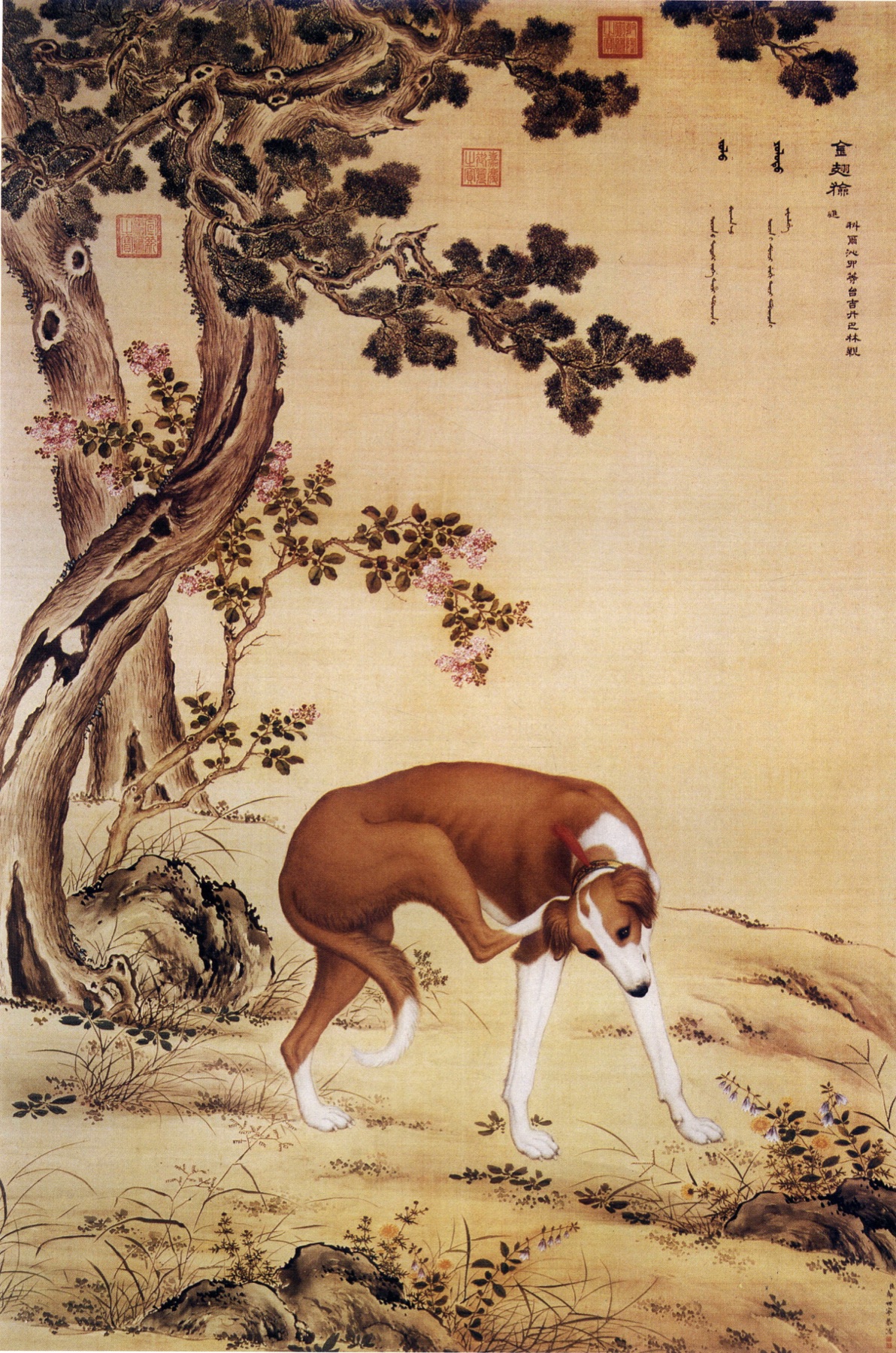
Modern catalogues often describe the slender dogs as Chinese greyhounds or connect them to Xigou imagery. Those are useful morphological comparisons, not Qing-period breed names. The same caution applies to Castiglione’s Zhuyin Xini Gou Tu (竹蔭西猊狗圖), shown on the home page: it records a court hound, not a Shaanxi standard plate.
Image record: Wikimedia Commons — Zhuyin Xini Gou Tu.
Selected chronology
A timeline with the gaps left visible.
Tang tomb murals
Prince Yide’s dog-and-falconer panel and Prince Zhanghuai’s hunting procession document specialised hounds in the Qianling tomb landscape.
Qing court dog portraiture
Named tribute dogs appear in imperial albums and individual portraits. Their modern breed identification remains interpretive.
A documentary field photograph
A Japanese survey photograph labels slender Mongolian hunting dogs as xigou, recording the word in a regional working context.
Modern institutional record
CKU begins a Shaanxi Xigou conservation programme, holds appraisal and registration activity, then publishes a valid standard dated November 2017.
Genomic evidence
Three peer-reviewed datasets describe diversity, homozygosity and complex ancestry in sampled Shaanxi sighthounds.
Origins
Contact across Eurasia remains an open question.
The feathered Shaanxi type invites comparison with Salukis and Central Asian Tazys. Geography makes contact plausible; morphology makes the question compelling. Neither establishes direction or date.
Whole-genome research published in 2023 placed seven sampled Shaanxi sighthounds close to European sighthounds in its analyses, while also concluding that sighthounds have multiple origins and extensive admixture. It did not produce a Shaanxi-specific recipe assigning percentages to Greyhound, Whippet or Saluki ancestors.
Denser modern sampling, documented geographic provenance and ancient DNA are needed to distinguish older Eurasian exchange from recent gene flow.
Research context: Multiple Origins and Genomic Basis of Complex Traits in Sighthounds.